Content Outline
Compliance Resource Library
Linked Resources to Review
The Compliance Team should review the resources provided below, which contain important forms, resources, and training information.
- NCFCA Safety Policy
- Family Orientation Video Script
- Speech Rules
- TP Rules
- LD Rules
- Judging Debate—Lincoln Douglas Video Script
- Judging Debate—Team Policy Video Script
- TP Judge Guide
- LD Judge Guide
- Speech Head Judge Instructions
- League Policies
- Debating with Integrity (Christy Shipe, Debate Chair)
- Compliance Policies Page
- Compliance Rules and Policies Video Transcript
The Compliance Leads should utilize the following linked resources.
- 2026 Printable Compliance Lead Checklist
- Sample Welcome Letters for Compliance Teams (online and in person)
- Ask your RCD for a Level 1 Speech/Debate Adjudication Chart if you are a CL but not an RCD
- Jr Compliance Field Trip Script
Terms to Know
Adjudication-The process of carefully examining a question brought to the attention of the Compliance Team by unbiased and accurate means, enabling the National Adjudication Team to make a fair determination.
National Adjudication Team (NAT)- The team working to ensure fair competition and consistent application of the rules across the country by gathering information from CLs/RCs/RCCs about potential rule violations and making determinations about penalties.
Recording Partner- The member of a Compliance Team who primarily serves the role of recording information and conversations.
Speaking Partner- The member of a Compliance Team who primarily serves the role of conversing with judges and affiliates.
NCFCA Admin- The technology within the NCFCA competition platform that allows the Compliance Team to communicate with judges and affiliates, to document Compliance Team activity, and to communicate with other departments during a tournament.
CQR- Compliance Query Request. The name given to the digital form the Compliance Team may ask a questioner to fill out if the Compliance Team believes an adjudication might be necessary.
Chat- A function on the NCFCA Admin that allows judges and affiliates to submit questions to the Compliance Team.
Message Monitor- A designated member of the Compliance Team that primarily monitors incoming questions via the Chat. Typically, a Message Monitor is only needed for larger tournaments. For smaller tournaments, the Compliance Lead can monitor incoming questions.
Discussion Points- The specific verbiage a Compliance Team should use as they conduct a Family Meeting. This verbiage should come from the National Adjudication Team (or RCC) and be passed down to the CL.
NCR- non-compliant rank (no longer used starting in the 2026 season)
NFA- no further action
Verbiage Examples
Communicating NAT decisions during Family Meeting
- Script resubmit:
For all issues except missional/content changes: “The changes discussed will need to be made to your script and the script must be submitted to your RC (email address) before the next round of competition for your event.”
For Level 3 missional/content issues: “The changes discussed will need to be made to your script and the script must be submitted to DirectorOfCompetition@NCFCA.org by (establish time with NAT).”
- No Penalty:
“The National Adjudication Leadership Team has determined there is no rule violation.”
Verbiage for Family Meeting involving Speech non-script issue:
After issue and rule are stated: "The Compliance Staff is reviewing _(potential rule violation)_for round____ only as this was the round that the issue was brought to our attention.”
Verbiage for meeting with a team or student concerned that an opponent violated a rule:
- We want to know students have discussed the concern with an adult to evaluate whether there is a violation of a rule
- We encourage students to assume the best about the intentions of their fellow competitors
- We are not able to evaluate everything that happened in a round and trust our judges to make the best decision
- If there is a potential rule violation, we would like to know the relevant facts and have them in writing in a CQR
- This allows us to evaluate further, get direction from the National Adjudication Team, and provide education or corrective action if needed.
- Once a rule violation is reported to us, we consider it to be a confidential matter between the competitor or competitors that potentially violated a rule, and tournament administration. This includes the outcome for the team being questioned.
- We understand that students and parents bringing a question to compliance often want to know the “answer” (what the outcome was) so they can then educate their club on how to stay in compliance with the rules in the future. This creates a tension between the goal to help NCFCA families and clubs understand how to apply NCFCA rules and guidelines, and the promise that we make to keep what happens in family meetings confidential. Based on our mission and values the Compliance team chooses to err on the side of confidentiality. (NEW for 2026: Debate Penalties will be seen on all the ballots in the round; the opponents will see any penalties applied after the tournament.)
Verbiage for a Team being brought to Compliance:
- When we receive a compliance query, our policy is to treat it as a question rather than an accusation.
- We evaluate each query as a question of the issue in question versus the rules and policies of NCFCA—not as the competitor(s) versus fellow competitor(s) or parents or judges or observers (any of whom may bring a query).
- We encourage competitors who find themselves to be subjects of a compliance query (along with their parents) to join us in thinking with grace about who may have initiated the query and why. It is especially important to remember that it may not be a fellow competitor who raised a question about the competition round—it could be a judge, observer, or a concerned parent.
- The role of Compliance is to gather information…. etc.
When do we say (after showing rules to clarify or taking a CQR) “Please rank the student as if in compliance with the rules” and when do we say “Please use your discretion as a judge as to how you weigh this issue into your ballot ranking and feedback"?
In the past, (for the most part), we have used the former response when conversing with a judge on an objective issue (e.g., student gave Impromptu speech using a note card, student placed an object on the judge table, etc.) and the latter response when conversing with a judge on a subjective issue (e.g., questions about adequate sources in a speech, questions about exceeding the number of quoted words in a speech, etc.). Since both of these responses carry a measure of potential judge biasing, a better response in either situation is "Thank you for your report. We will investigate the matter. Please continue to fill out your ballot with the information you have from the round."
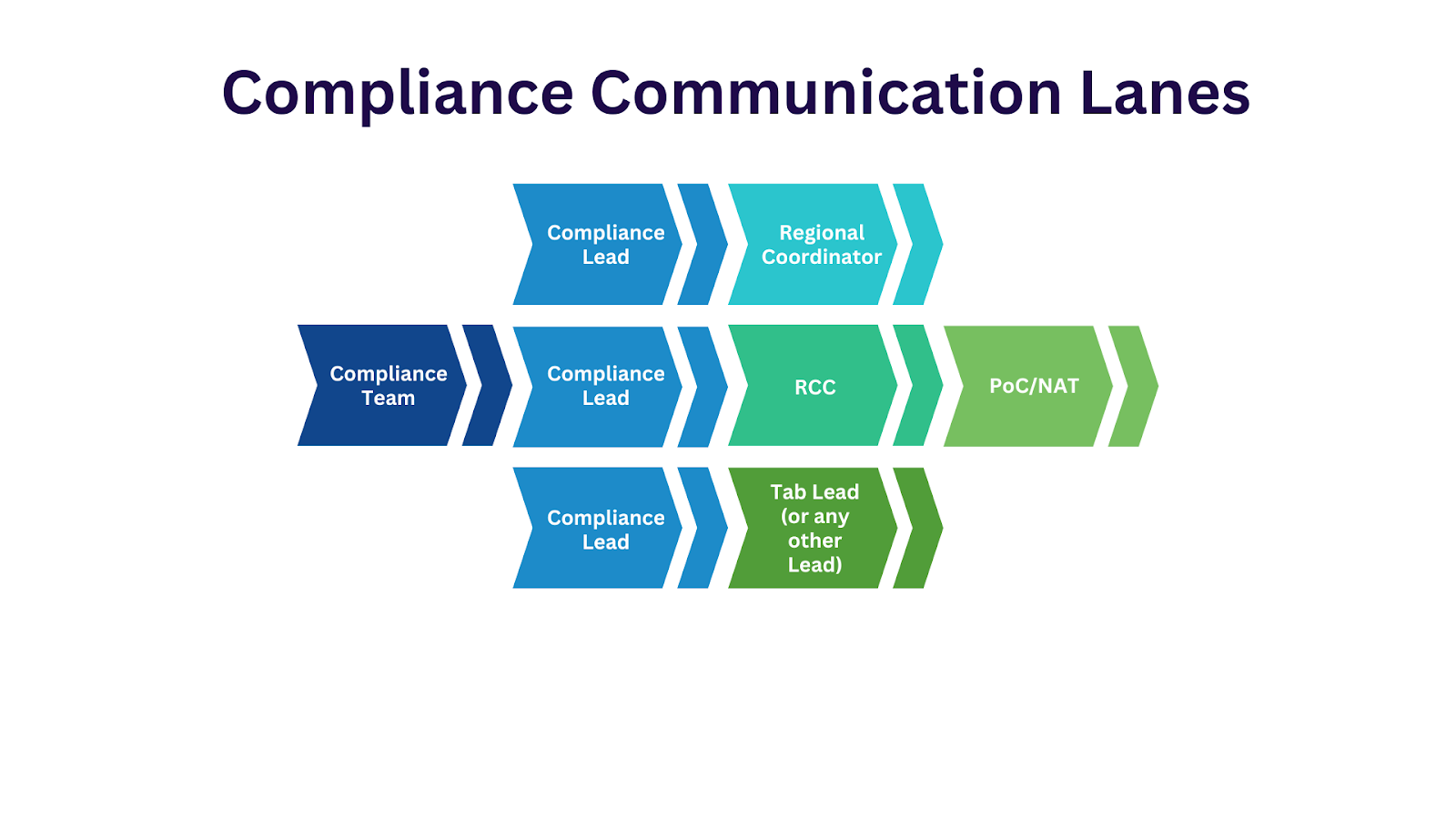
Communication Lanes
Staying in your “communication lane” preserves the integrity of our processes.