
Content Outline
Preparing for Debate Elimination Rounds
Before Proceeding to Elim Prep
Click on TP Debate Penalties and LD Debate Penalties and confirm that all penalties from Compliance have been applied correctly.
Requesting Clearance from Compliance (Tab Lead)
- Once all debate ballots are in, all debate penalties have been applied and reviewed, and all debate rounds have been approved, the Tab Lead should ask the Compliance Lead if that style of debate is clear to proceed to elimination rounds.
- If Compliance does not grant clearance, the Tab Team may still review Elim Prep with the understanding that checks will need to be redone if any new compliance adjustments come through. However, the Tab Lead must not Approve Elimination until Compliance has given clearance and all checks have been completed.
Review Preliminary Seeds (Tab Team)
- Select Elim Prep from the left navigation.
- Preliminary seeds are available after Round 2 ballots have been submitted. The TD/RC or Compliance Lead may request information regarding the current preliminary seed for a team.
- Select Round 6 to view the preliminary rankings after all 6 rounds are complete.
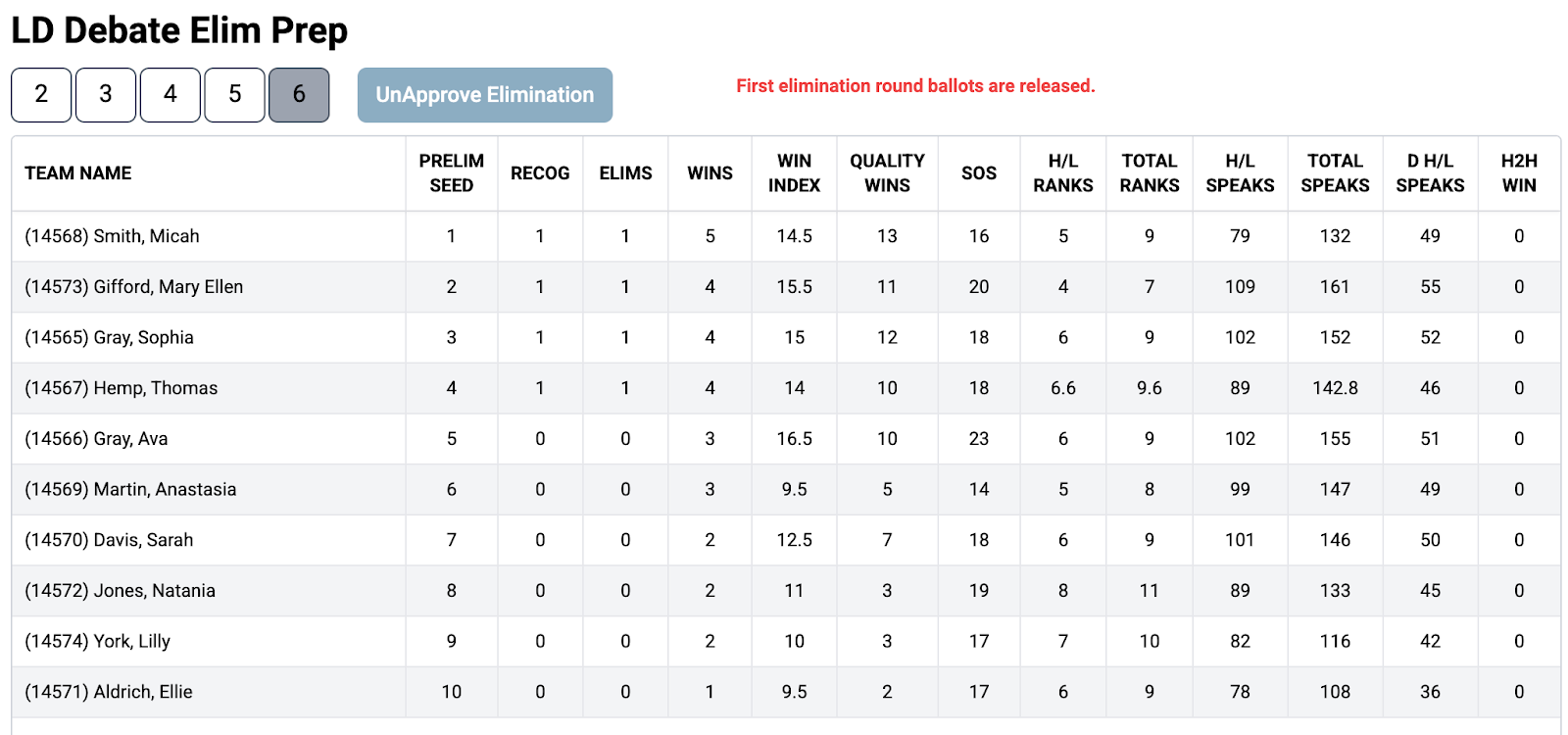
Example Debate Elim Prep Display
- Review the preliminary seeds.
- Teams will be listed in order of their preliminary seed from top to bottom.
- Confirm that the number of teams being recognized and the number advancing to elimination rounds are in accordance with the 2026 Qualification System.
- Any team with a winning record (4 or more wins) should have a 1 in the “Recog” column.
- If this is a Regional Qualifier, there could be stranded winning records (i.e., more winning records than accommodated in prescribed brackets); report them to the TD/RC. Stranded winning records will be announced at awards. Make a note to confirm that these appear on the awards announcement sheets.
- For Regional Qualifiers, the number recognized (“Recog”) should be equal to the number expected for prescribed brackets (plus any stranded winning records, if applicable). For national-level tournaments, only winning records will be recognized.
- Teams advancing to debate in elimination rounds will have a 1 in the Elim column. This should include all winning records at a national-level tournament.
- NOTE: In the rare event of >64 winning records at a national-level tournament, alert the POC before approving Elim seeds.
- Any team with a winning record (4 or more wins) should have a 1 in the “Recog” column.
- Confirm that all penalties are reflected in the seeding.
- If there were any Loss of Round or Speaker Point penalties, confirm that they have been applied by reviewing the team’s win/loss record and/or speaker points.
- Ranking Teams
- Rankings. Teams will be ranked by win/loss record.
- Breaking Ties. When two or more teams have the same win/loss record, the following methods will be used, in the order listed, to break the tie:
- Win Index. The average of Quality Wins and Strength of Schedule. (Strength of Schedule is the sum of wins of all the six opponents. This is omitted as a tie breaker because it is mathematically impossible to have an equal Win Index and Quality Wins without an equal Strength of Schedule.) The team with the higher Win Index wins the tie-breaker.
- Quality Wins. The sum of opponent wins in the rounds a team won. The team with the highest Quality Win Score wins the tie-breaker.
- Adjusted High-Low Speaker Ranks. The sum of speaker ranks excluding the highest and lowest scoring ballots. The team with the best adjusted speaker rank wins the tie-breaker.
- Total Speaker Ranks. The sum of room ranks for all six rounds. The team with the best Room Rank wins the tie-breaker.
- Adjusted High-Low Team Speaker Points. The sum of Team Speaker Points excluding the highest and lowest scoring ballots. The team with the highest Adjusted Speaker Points wins the tie-breaker minus any penalties.
- Total Team Speaker Points. The sum of team speaker points from all preliminary rounds. The team with the highest Team Speaker Points wins the tie-breaker minus any penalties
- Adjusted Double High-Low Team Speaker Points. The sum of Team Speaker Points excluding the two highest and two lowest scoring ballots. The team with the highest total adjusted Team Speaker Points wins the tie-breaker.
- Head-to-Head. If two teams faced each other in preliminary competition before this point, the team who won the round wins the tie break.
- Coin Toss. When all the above methods fail to resolve the tie, an electronic coin toss is used to determine which team wins the tie break.
- Spot-Check Values. As always, we are looking for reasonableness in the results. Click on a competitor’s name to verify the number of wins, win index, speaker ranks, etc. Competitors affected by penalties, forfeits, or byes are good subjects for spot-checking.
- Verify Tie Breaks. Follow the logic of each tie break to confirm ties are being broken correctly.
- Understanding Win Index
- See Appendix A [LINK] for an example of how Win Index is calculated.
- Prepare hand-written brackets. Using the seeds that you verified from Elim Prep following Round 6, fill out brackets for both styles of debates. Print the blank bracket based on the number of elimination rounds for the tournament. (See Appendix B)
- Matching Teams
- Ranking and seeding. Elimination round pairings are established in accordance with each team’s preliminary ranking. The highest-ranking team meets the lowest ranking team, the second highest meets the second lowest, etc.; this is illustrated by the bracket.
- Locked Sides. If the two teams have faced each other once in preliminary rounds, the teams switch sides for elimination competition. Confirm using the Cum Report (available in Elim Prep Round 6 rankings by clicking the team name) that if they have met in preliminary rounds, the ballots and brackets reflect switched sides.
- Flip for Sides. If the two teams have faced each other twice in the preliminary rounds or have never met, an electronic coin toss determines the side each team will take.
Approve Elimination
- Once Round 6 preliminary seeds have been verified by the Tab Team and clearance has been given by the Compliance Lead, the Tab Lead may Approve Elimination.
- This will generate brackets and ballots for the first elimination round.
- The Tab Team should verify that their hand-written brackets match the brackets displayed, including seeds.
- The Tab Team should verify that any teams matched for the second time have switched sides.
Review & Release Ballots (Tab Lead)
- Once brackets, ballots, and number of judges needed have all been reviewed and found to be correct, the Tab Lead should Release Ballots to Staff 1–1.5 hours before the round is scheduled to begin to allow the Ballot Admin Team to control ballot release.
Prepare Announcement Sheets
- Select Reports, followed by Announcement Sheet.
- Verify that competitors on the break announcement sheet match the results in Elim Prep and that no disqualified competitors are listed.
- For in-person tournaments:
- Print a copy for the TD/RC and place in a folder or manilla envelope.
- For online tournaments:
- Save as PDF and share electronically according to the TD/RC’s preferences.
Prepare Wall Postings for In-Person Tournaments (Tab Lead & Team Members)
- Prepare Wall Postings by selecting Report, followed by Wall Postings.
- Print the quantity of Wall Postings requested by the TD/RC or Communications Lead. The quantity needed may be reduced at some point in elimination rounds.
- Continue to organize sets of postings as reasonable for the facility and size of competition.
- Place the prepared manilla envelope(s) aside for the Communications Lead no later than 30 minutes prior to the scheduled start of the round.
- If needed, remind the Communications Lead to return manilla envelopes and paper clips for the next round.
What should I look for when preparing for Debate Elim rounds?
- Be sure all preliminary penalties have been applied and verified.
- Confirm the correct number of debaters are being recognized and advancing to elimination rounds per the 2026 Qualification System.
- Follow the logic of all tie breaks to verify accurate rankings.
- Check for reasonableness in preliminary seeds, particularly for teams with a penalty.
- Spot-check Elim Prep ranking and tie-breaking values.
- Receive clearance from the Compliance Lead before you Approve Elimination.
- Verify that the first elimination round brackets and ballots appear as expected.
- Confirm the correct number of judges are needed on ballots for the first elimination round.
- Be sure to release ballots to the Ballot Admin team on time.
- Verify and prepare Announcement Sheets for the TD/RC.
- Prepare Wall postings for in-person tournaments and have ready for the Communications Lead no later than 30 minutes before the scheduled start of the round.